
- TATE TIDBITS
- ABOUT
- ACTIVITIES
- RESOURCES
- EXHIBITS
- GIFT SHOP
- CLUBS & ORGANIZATIONS
 |

Wine & Dine Your Valentine
“Date Night at the Museums”
to benefit the Casper Museum Consortium
Click here for complete details |
|
|
|

The book sells for $21 in our gift shop.
If you can't visit our gift shop, give us a call
or visit this site if you'd like to order one. |
"Dee and the Mammoth"
by Gene Gagliano, illustrated by Zak Pullen.
The book is here! Available now at the Tate Museum and these other fine Wyoming retailers.
"Dee and the Mammoth" is a children's book written by Gene Gagliano of Buffalo, WY and illustrated by Zak Pullen of Casper. It is inspired by the discovery of Dee the Mammoth, but in this story, Dee is a little girl who tells a story about a mammoth through letters from her dad who is working on a mammoth dig. The book also includes a DVD which features an audio version of the book, and a doumentary film about the Tate Museum's Dee the Mammoth.
- Ralph’s Books, 215 S. Montana Ave., Casper, WY 82609, 307-234-0308
- Wind City Books, 152 S. Center St., Casper, WY 82601, 307-315-6003
- Campbell County Rockpile Museum, 900 W. Second St., Gillette, WY, 82716-3405, 307-682-5723
- Ft. Caspar Museum, 4001 Ft. Caspar Rd., Casper, WY, 82604, 307-235-8462
- Nicolaysen Art Museum, 400 E. Collins Dr., Casper, WY, 82601, 307-235-5247
- Dinosaur Journey, 550 Jurassic Ct., Fruita, CO 970-434-9814
- Washakie Museum, 2200 Big Horn Ave., Worland, WY 307-347-4102
Wholesale orders can be made by visiting this site and downloading the form, then sending it to the Tate Museum at the address on the form. We also have five of Zak's original paintings for the book on display in the museum for a little while. Come in and see them. They are fantastic. |
|
|
| Museum Hours: |
 |
The Tate Museum
and Dee the Mammoth
are both on Facebook.

Tate Museum
Dee the Mammoth |
LEE REX
CONCRETION WEBCAM |
 |
Click image to view live image.
Username = cc
Password = cc |
|
| Monday - Friday |
| |
9:00 AM - 5:00 PM |
| Saturday |
| |
10:00 AM - 4:00 PM |
| Sunday |
| |
Closed |
| |
|
|
| Phone: |
| |
307.268.2447 |
|
History of the Museum
The Tate Geological Museum was founded in 1980 through a gift from Marion and Inez Tate. It was originally designated as the Tate Earth Science Center and Mineralogical Museum. Because ‘geological' encompasses earth science, mineralogy and paleontology, the name was changed to the Tate Geological Museum in 2001.
Located on the Casper College campus, the museum is a great resource to the community. Many local schools and groups come to the museum to add to their students learning experience.
One of a minute number of geology and paleontology museums in Wyoming, the Tate houses a collection of over 3000 fossil and mineral specimens. Museum staff are always on hand to answer questions, help identify items visitors bring in, and make your visit to the museum an enjoyable experience. The Tate is certainly a great addition to anyone's list of 'must see sites' when traveling through Wyoming. |
Museum Staff
 |
Deanna K. Schaff
Tate Geological Museum Director
| Weblink |
Deanna’s road to being Director of the Tate Museum is certainly not the one most traveled. The journey started with a bachelor’s degree in Mathematics and Education and for most of the time, with some extended side trips, she was a 7-12 mathematics and science teacher in eastern Colorado. After finishing a Masters Degree at the University of Wyoming, Deanna moved to Casper to manage the Math Learning Center and teach math. She then became a part time administrator as the Physical Science Division Chair and during this time was a member of the Tate Museum advisory board. Beginning in 2009 she became the interim Director of the Tate Museum and in June of 2010 was made the permanent director of the museum. Away from the museum most of her time is spent involved with her husband, Bob, two sons and five grandchildren. |
|
 |
Sue Easton
Tate Geological Museum Assistant
| Weblink | |
|
 |
Russell Hawley
Education Specialist
| Weblink |
(307) 268-2447
(800) 442-2963 ext. 2447
Russell graduated from the University of Colorado in 1991 with a degree in fine art. His artwork has appeared in the America's Smithsonian anniversary traveling exhibition, in "Islands in the Cosmos: The Evolution of Life on Land" by Dr. Dale A. Russell, in "Oceans of Kansas" by Michael Everhart, and several issues of Prehistoric Times magazine. Aside from being the Tate Geological Museum's Educational Specialist, Russels also gives tours, writes articles for the museum newsletter, and produces illustrations for the museum displays.
|
|
 |
J.P. Cavigelli 
Field/Prep Coordinator
| Weblink |
(307) 268-3008
(800) 442-2963 ext. 3008
J.P. is the Field Operations Specialist, Collections Manager and Prep Lab Manager for the museum. JP came to Casper in 2004 from Laramie. Before coming to the Tate, he worked on and off in paleontology for 14 years, doing field work as well as a two year post as the collections manager for the University of Wyoming Department of Geology and Geophysics. He has had the good fortune of having been invited to join international paleontological expeditions to Mongolia, Niger (twice), Tanzania (twice) and North Dakota. In his spare time JP collects fossils, watches birds and plays hockey. |
|
 |
Patti Wood Finkle 
Exhibits Specialist
| Weblink |
(307) 268-3026
(800) 442-2963 ext. 2447
Patti graduated from Texas Tech University in 2009 with a Master’s degree in Museum Science, with a focus on exhibits and collections. Her undergraduate degree in Anthropology is from Texas A&M University where she focused on the curation of archaeological collections. Patti has helped the museum update old exhibits and install new ones, most notably the Pleistocene exhibit, featuring Dee the Mammoth. In addition to her Tate Museum duties, Patti also works in conjunction with the Werner Wildlife Museum, also located on campus. |
|
| CURATORS |
|
 |
Dr. Kent Sundell
Tate Geological Museum Curator
Geology Instructor
| Weblink |
(307) 268-2498
(800) 442-2963 ext. 2498
Geology allows Dr. Sundell to be outdoors and apply a broad knowledge of science (chemistry, physics, biology, math) towards a better understanding of our Earth. From the historical and esoteric (paleontology, plate tectonics, paleomagnetism, climate change) to the practical application of finding a high paying job (oil, gas, and mineral exploration, geophysics, geochemistry, geohydrology, environmental geology), geology makes life fun and mentally stimulating. |
|
 |
Melissa Connely
Tate Geological Museum Curator
Dean, School of Science
| Weblink |
Melissa has been a student of Earth Science all her life. She joined the Tate Geological Museum crew in 1992 as a volunteer while going to school full time. She has worked her way up from being a volunteer, lab manager, geology instructor, and Director to Curator and Dean for the School of Science. Melissa loves to discover new things and promotes an appreciation for the natural world. She has a Master’s Degree in Geology with an emphasis in stratigraphy and paleoecology. She has worked in the field for 16 years with various institutions. Although she has a special fondness for sauropods, she delights in the study of any rock or fossil and shares that enthusiasm with her students and colleagues. |
| |
Volunteering at the Museum
Volunteers often represent a large portion of any museums work force. Here at the Tate Geological Museum, we offer a variety of activities for those that are interested in taking part.
Many of our current volunteers assist with display construction, helping out in the gift shop, giving tours, and also working in the fossil preparation lab--just to name a few. Come on up and see if the Tate might be the place for you.
|
Museum Membership
All members to the Tate Museum receive the bi-monthly Tate Museum newsletter, Tate Museum Geological Times, and a membership gift card that is good for a 10% discount at the museum gift shop during their membership.
Members may sign-up on an individual or business basis
|
Tate Newsletter
The Tate puts out a bi-monthly newsletter called the Tate Museum Geological Times. It's chock full of news, information and fun facts.
As a member of the Tate Museum you receive this newsletter for free. Please see the Membership Information above for details on how to join the Tate Museum family.
 |
| 2011 |
2010 |
2009 |
|
|
|
| 2008 |
2007 |
|
|
|
|
|
|
Schedule of Events
Info on the 2011 digs can be found below under the gray "Tate Summer Digs" tab below. 2012 will likely be similar. We will be doing two Digs. One on July 9-13 and the other September 10-14.
The Annual Tate Conference is scheduled for June 1-3, 2012. Details including registration forms can be found under the gray "Annual Summer Conference" tab below.
|
Saturday Club
The Saturday club is going on hiatus after September...
The last Saturday Club for the year will be held on September 3rd. It will consist of a field trip to a local outcrop to hunt for real minerals and fossils. We will be taking a break from Saturday Club until further notice. If you are interested in more details, please call the museum at 307-268-2447 and ask for Russell Hawley.
|
Open House
Each year on the first Saturday of December, the Tate Museum hosts an open house, which features a variety of musuem activities. See this space in November for more info. |
Tate Summer Digs
2012 Field Expeditions
We are offering two weeks of Field Expeditions in 2012:
July 9 through 13
and
September 10 through 14
The goals of Tate Geological Museum paleontology field trips are to offer fun educational experiences while building up the museum’s collections for display and/or research. The popular summer dinosaur digs will again be available for interested members of the public. Registration will be through the museum and CEU credit will be available upon request. The fee this year will be $800/person. This includes six nights of lodging, six dinners, five field lunches, four continental breakfasts at the hotel in Lusk, snacks and soft drinks/water, and all ground transportation from Casper.

|
Museum Tours
Come and take a guided tour of the museum. Find out about dinosaurs, minerals, gems and check out our fantastic exhibits.
A group tour makes a great field trip for any class. Be it at the end of a unit, or as an introductory look into what students will be studying in class, a tour of the Tate Geological Museum is a wonderful addition to any lesson plan. We have a wealth of specimens and fossil casts that students can handle and examine during thei r visit. Open access at the Fossil Preparation Lab window gives students a chance to see some of the "behind the scenes" operations you don't always get to see at every museum. If you'd like a more interactive visit to the museum, we also have scavenger hunt questionnaires for students to fill out, giving them a chance to get more involved with their museum visit.
If you can't make it to the museum for a tour we also have a selection of Teaching Trunks filled with a great variety of specimens, fossil casts, books, posters and many other resources that can be checked out for use in the classroom.
It is best to schedule your tour or classroom visit as far in advance as possible to ensure you get the day and time that best fits your schedule.
Not sure if you will be able to attend a tour at the museum? We can bring the museum to you! Tate staff members have made presentations to local classrooms and community groups, as well as accompanied classes on field trips. Museum staff arrive with a number of materials, from fossil casts to the real thing, and always have plenty of hands-on items to be passed around the room.
Call today to make your appointment!
(307) 268-2447 ~ (800) 442-2963, ext. 2447

|
Fundraiser Events
Want to support the museum and have some fun at the same time? Come join us at one of our annual fund raising events!
Complete details coming soon. |
For more information contact:
Tate Geological Museum
Casper College
125 College Drive
Casper, WY 82601
Phone: 307-268-2447 |
Museum Hours:
9 am - 5 pm Weekdays
10 am - 4 pm Saturdays
Closed Sundays and Major Holidays. |
Location:
Southern most campus entrance off Casper Mountain Road
|
Annual Summer Conference
Tate Conference 2012
"Invertebrates: Spineless Wonders"
The 18th annual Tate Conference will be June 1-3, 2012 here at Casper College. The theme will be invertebrate fossils. The tentative plan is to have Friday and Sunday (June 1 and 3) be field trip days and Saturday be a day of talks. We are currently looking for speakers and planning field trips. If you are interested in speaking, please email JP Cavigelli here.
Registration
Registration is not open yet, but soon...
Registration, payment and medical release forms should be sent to :
Deanna Schaff
Tate Museum
125 College Dr.
Casper College
Casper, WY 82601
Payment
Payment may be made by check, credit card or via the secure PayPal link below.
Accomodations
The Tate Museum will reserve a block of rooms at the Ramada Plaza Riverside. The hotel is at 300 West F St., which is just north of the I-25 & Poplar St. intersection. The hotel allows pets for a small additional fee. The Ramada's phone number is (307) 235-2531.
|
| |
|
Teaching Trunks
Exciting hands-on learning for your students!
Each trunk contains various specimens, activities, replicas, videos, books, resource materials and a teachers guide.
Funded by the Board of Cooperative Educational Services (B.O.C.E.S.) and Classroom Wyoming
These trunks are available for teachers in Wyoming to check out for use in the classroom. Contents are targeted to enhance 2nd & 4th grade curricula and outcome criteria; however, they can be used for any grade level. The trunks have been designed and created by a cooperative team of Tate Museum staff and Natrona County School District teachers.
Teaching trunks can be checked out for a two week period, which can be extended if the trunk does not have a waiting list.
Trunks are available to teachers free of charge.
To reserve a trunk for a two week period, please contact the Tate reception desk (307) 268-2447
The Tate Teaching Trunks can help the teacher in the classroom in many ways. Not only do they have hands on samples of various rocks, minerals and fossils, but each trunk also comes with a great selection of posters, books, videos and activities that make the teaching of various aspects of Earth Science fun and easy. The trunks are great for grades 1,2,3,4 and 6 to reach the goals set in the Earth Science requirements.
|
| |
 |
Rocks and Minerals [inside trunk]
Casper is a great place to learn about rocks and minerals. Investigate the properties: hardness, crystal shape, cleavage, color, magnetism, streak, acid reactions. Learn to sort and classify rocks. Find out about local sites.
|
 |
General Geology and Economic Geology in Wyoming [inside trunk]
Activities about volcanoes, earthquakes, erosion, deposition and more are contained within this trunk. Students can also learn about oil, coal, gas, uranium, trona, bentonite and other resources that are important to Wyoming.
|
 |
Fossils [inside trunk]
What is a fossil - and how is it formed? This trunk contains examples of fossils through geologic time and shows what they can teach us about ancient environments.
|
 |
Dinosaurs [inside trunk]
Students can learn about the different kinds of dinosaurs, what environments they lived in and also where they lived. Teacher's guide includes many worksheets and there are also many hands on activities aimed primarily at 2nd graders.
|
Scavenger Hunt
Tate Museum Scavenger Hunt
Do you want to make your visit to the Tate Museum more interactive than just looking at displays?
Here is a list of questions to help you make a customized visit of activities for your and or/ your students.
Please note that displays in the museum are often changing and new ones are being constructed. This list may not always be as updated as our displays.
- During which epoch did Dee live?
- Were mammoths herbivores, omnivores, or carnivores? How do we know this?
- Who has a bigger brain, humans or Tyrannosaurus rex?
- What product mined in Wyoming is used in kitty litter?
- Where was Wyoming located during the Cambrian period?
- Describe the climate in Wyoming during Eocene time. How do we know this?
- On the touch table is a fossil that might be described as the "Milky Way." What kind of fossil is this and what part are you seeing in the rock?
- Name the three types of meteorites. Which is most common?
- Name the two types of jade.
- Which Oligocene animal has a tooth shaped like the Greek letter pi?
- How many bones are there in a Triceratops jaw?
- What is a theropod? How many toes do they have?
- Which case has a penny in it and what is its purpose?
- What shape are the scales on a gar?
- Where was Dee's skull found? Describe a hypothesis as to why the skull was not near the rest of the skeleton.
- What is "fool's gold" and how is it different from gold?
- What is the chemical formula for Stibnite? Is it a silicate or non-silicate mineral?
- What was one of the largest predators of the White River badlands?
- What marine animal had the largest eye of any vertebrate?
- What kind of animal is "Twinkle Toes?"
- During what era was the granite that makes up the core of Casper Mountain formed?
- What kind of teeth does a whale need to eat a mixed diet? Use the whale wheel to help answer this question. Can Basilosaurus eat a mixed diet?
- What type of animal is Oomtar? Where was he discovered?
- What do the dark gray circular areas on Dee's skull indicate?
Click here to print a version of this scavenger hunt (with spaces for answers) for your Tate Museum visit.
We encourage you to come on in to the museum and try the scavenger hunt, but if you must know the answers... click here. |
Prehistoric FAQ's
Here are some of the most Frequently Asked Questions at the Tate Museum.
If you have a question that isn't on this list, feel free to email it to:
Russell Hawley, Education Specialist
- Was Tyrannosaurus rex a predator or a scavenger?
Answer
- Why did the dinosaurs become extinct?
Answer
- Did birds really evolve from dinosaurs?
Answer
- Were dinosaurs warm-blooded or cold-blooded?
Answer
- How fast was Velociraptor?
Answer
- How big was Velociraptor?
Answer
- How smart was Velociraptor?
Answer
- Is it true that if you don't move, a Tyrannosaurus can't see you?
Answer
- Why isn't a plesiosaur a dinosaur?
Answer
- So if a plesiosaur wasn't a dinosaur, what was it?
Answer
- What was the biggest dinosaur?
Answer
- Why did they change the name of Brontosaurus to Apatosaurus? Is it because they had attached the wrong head to the wrong skeleton?
Answer
- What's the difference between an ammonite and a nautiloid?
Answer
- How big was a pterodactyl?
Answer
- How can you tell real gold apart from fool's gold?
Answer
- What was the fastest dinosaur? It was Velociraptor, right?
Answer
- How can we tell what dinosaurs ate?
Answer
- What's the difference between Allosaurus and Tyrannosaurus?
Answer
- What kinds of sounds did dinosaurs make?
Answer
Listen to an example of a Parahorn
- What color were dinosaurs?
Answer
- Wyoming used to be under the ocean, right? When was that?
Answer
- Where did the fossils in the Tate Museum come from? Are any of them from Wyoming?
Answer
- Did Dilophosaurus really spit poison?
Answer
- How can we tell how old dinosaur bones are?
Answer
- Why don't you have the real Tyrannosaurus rex skull on display?
Answer
- What was the smallest dinosaur?
Answer
- Which state has the most dinosaur fossils?
Answer
- Is it true that Spinosaurus was really bigger than Tyrannosaurus rex?
Answer
|
Educational Resource Links
- Wyoming Sites
- Dinosaur Sites
- Fossil Mammals Sites
- Marine Reptile Sites
- Rock and Minueral Sites
- General Geology Sites
- Membership Sites
|
Virtual Fieldtrips
Visit the world without leaving home!
|
 |
|
Dee the Mammoth and the Pleistocene Exhibit
Dee the Mammoth is an 11,600 year old Columbian Mammoth who lived in the American West during the Pleistocene, or Ice Age. 65 to 70 years old when he died, Dee is unique in both his advanced age and his completeness.
Dee was discovered in 2006 by a backhoe operator who was preparing an oil well pad site north of Glenrock, WY. The operator, Dee Zimmerscheid, knew that he had hit something big when several large white bones were churned up from under his machine. He called in his site supervisor, Bill Allen and together they decided that it was time to call in the land owners and the experts.
It was determined that the bones were from a mammoth and that more of the huge mammal was probably located below the surface. Dr. Kent Sundell recommended that the oil well be moved over about 100 feet and the oil companies that were involved agreed. Additionally, the Allemand/Byrd family who owned the land and thus the bones, generously donated the skeleton to the Tate Geological Museum.
During three of the next four summers, over 300 mammoth bones were recovered from the site. After recovery, the bones were transported to the museum lab to be cleaned and cataloged. Many of the bones were complete and identifiable, making the staff and volunteer’s jobs in the lab easier. The skeletons completeness enabled the the Black Hills Institute of Geologic Research to reassemble and mount the mammoth for display in the museum where it can be seen today.
The Pleistocene Exhibit, featuring Dee, informs visitors about Wyoming’s Pleistocene environment, introduces a few of Dee’s contemporaries and discusses the differences and similarities between mammoths, mastodons and elephants. Visitors can play the PSI (Pleisto-Scene Investigation) game to determine, on their own, how the mammoth died and follow the Timeline of Discovery for a quick view of the events leading up to and occurring after the skeleton’s discovery. Watch a video on mammoths or look at photos and home videos from the field as you learn about the life and times of Dee the Mammoth.

We have this cool time-lapse video provided to us by the Black Hills Institute of Geological Research of them workingon mounting Dee's bones in their warehouse in Hill City, South Dakota. Click on the film reel below to watch.

|
| |
| |
Dino Den
The Dino Den is located in the front, northeast corner (opposite the gift shop) as you enter the museum. Created as a dinosaur discovery zone, it gives kids room to play and investigate on their own. The Dino Den features coloring, puzzles, a mineral ID game, fossil rubbings, touchable fossil casts and dino themed toys for all ages. Stop by to play and learn anytime!

|
Hall of Minerals
The Mineral Exhibits line the north wall of the museum and cover mineral types, diagnostic mineral features, silicates and non-silicates, Wyoming’s extractive resources and the state gemstone, Jade. Currently in the development stages, the extractive resources and mining in Wyoming cases will be receiving a face-lift to include more up to date mining practices as well as a brief review of the history of mining in Wyoming.

|
Walk Through Time
The Walk Through Time, located along the back (west) wall of the museum takes visitors back through time from the Holocene hunter and gatherers of North America right back to the formation of the earth. Along the way there are several drawers with touch samples which allow visitors to interact with the fossils as they move back through time. Be sure to look for the plant fossils, the T.rex tooth, and the trilobites along the way.
 |
...Two Views...
............................... |
 |
|
Mesozoic Marine
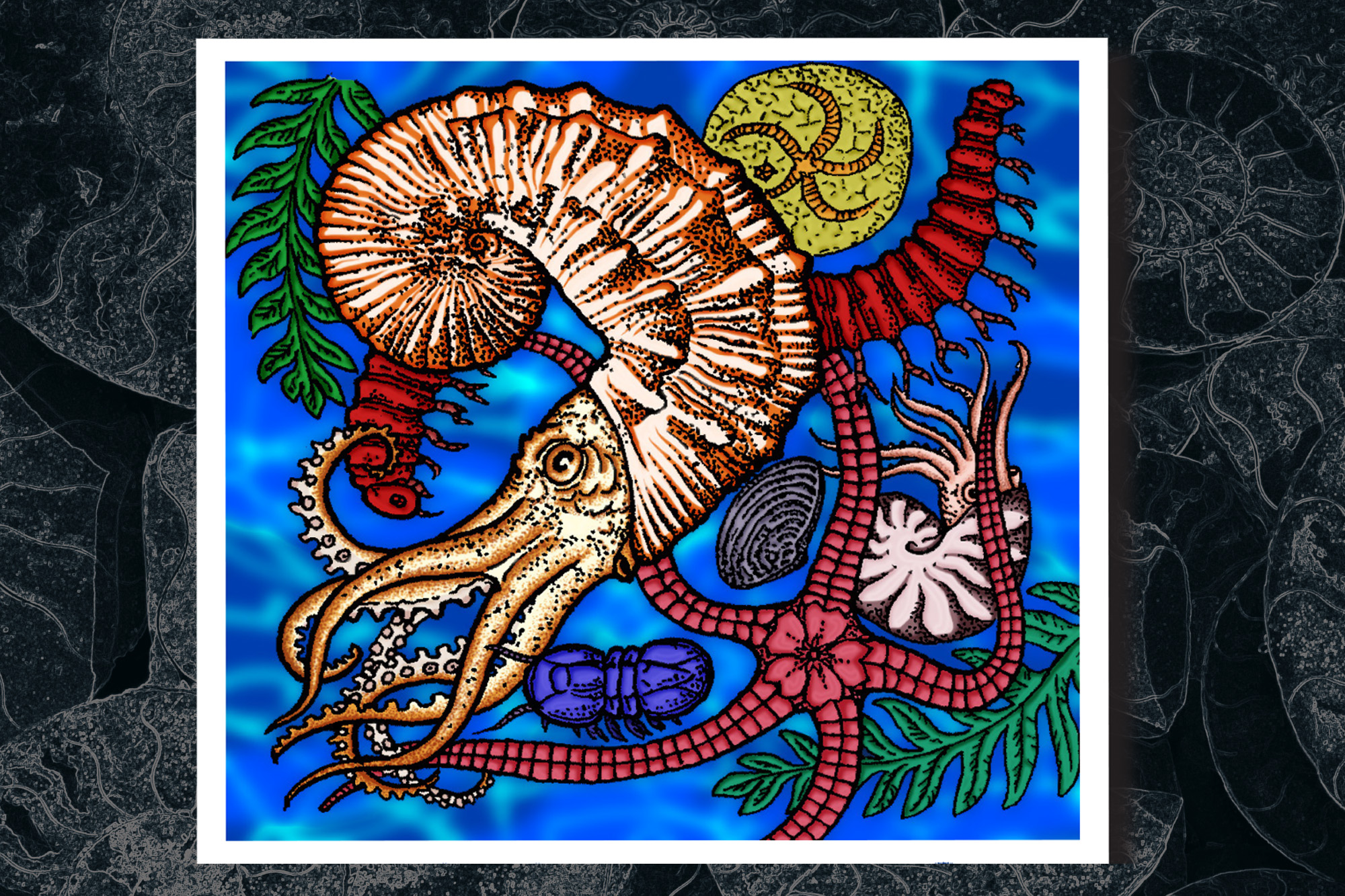
The Mesozoic Marine exhibit exposes the underwater world that existed here in Wyoming during much of the Triassic, Jurassic and Cretaceous. Wyoming’s warm, tropical seaways were home to a plethora of marine animals and some plants, including ammonites, belemnites, star shaped crinoids, ichthyosaurs, mosasaurs and hybodont sharks. Of particular interest (here at the Tate Museum, anyways) is the Sundance Plesiosaur (Tatenectes laramiensis), named for the founders of the museum Marion and Inez Tate.
 |
Bones of Oomtar the mosasaur found near the town of Midwest, north of Casper are featured inthe Marine mesozoic display |
 |
Mesozoic marine display includes mosauaurs, sharks, ammonites and more |
|
Mesozoic Terrestrial
It was the time of the dinosaurs. The Mesozoic Era is usually better known by its three periods, the Triassic, the Jurassic and the Cretaceous. The Mesozoic Terrestrial area highlights the massive size of the dinosaurs as well as a few of the features that made some of them terrifying and so fascinating. Stand next to a Torvosaur leg, see how big an Apatosaurus foot really was, check out the size of an Allosaurus claw and have a face-off with Stan the T-rex!
Our Cretaceous Corner is currently under construction, but will soon feature several Cretaceous dinosaurs including our Hadrosaur, Dead Sheep 148, portions of Gret the Triceratops (the triceratops is the Wyoming state dinosaur) and other cretaceous creatures.
The Mesozoic Aerial display introduces the pterosaurs that called Wyoming home. Jurassic pterosaur footprints have been discovered near Alcova Reservoir and models in the display have been reconstructed (to scale) from these footprints. These footprints also helped to solve the riddle of how pterosaurs walked when they were on the ground. Did they walk on two feet? On all four? Like a dog or a bat? Visit the Tate to find out the answer to this important question.
 |
A cast of the skull of Stan the T rex is a popular item at the Tate. |
 |
A claw of Allosaurus |
 |
The Tate's pterosaur tracks display features tracks found at Alcova, 40 miles south of Casper, one of the best places in the world for pterosaur tracks. |
|
Eocene of Wyoming
The Eocene Epoch had a warmer, wetter environment and large variety of animals flourished. The landscape was full of archaic mammals that were vastly different from mammals today. Conversely, the reptiles were amazingly similar to their modern counterparts. The Eocene display features a fossilized crab, turtles, fish, mammals, birds and feathers, crocodiles and alligators and plant pieces many of which were found in Wyoming. Learn about life after the dinosaurs, and find out for yourself how similar the Eocene reptiles were to modern reptiles.
 |
The Tate's Eocene display features 50 million year old fossils mostly from Wyoming... fishes, birds, mammals, turtles, crocodiles, insects, leaves and more. |
|
Oligocene/ White River of Wyoming
The Oligocene Epoch came after the Eocene. By this time dinosaurs had been extinct for about 30 million years, and mammals ruled the earth. The variety of fauna that lived during this time is well preserved in the White River Formation of Wyoming which is known for its preservation of mammals including oreodonts, titanotheres and predators such as the entelodont. See if you can find the skeleton of the three-toed horse and discover how different it is from the modern horse. How many differences can you find?
 |
This portion of the Tate Museum's White River display features a titanothere skull, a smaller rhino skull and a death assemblage of 11 small oreodonts. |
 |
The White River Diorama features reconstructions of the saber-toothed Hoplophoneus attcking a hapless oreodont. Cretaures that lived in burrows can be seen "underground". |
|
Prep Lab
The prep lab is where the specimens are cleaned and made ready for exhibit in the museum gallery. Our prep lab is visible to the public via a sliding glass window, so you can see what we are working on and even ask questions.
One of our main projects in the prep lab these days is Dead Sheep 148, a hadrosaur skeleton found in 2005. This jacket (at right) contains a beautifully articulated pelvis region of the animal. We have been working on it on and off in the lab for a few years, with an interruption to clean the mammoth skull. As of this writing, (Jan 2011) we are doing the final touches on it to put it on display. (Dead Sheep 148 is named after a recently deceased ewe that was lying in the vicinity of the hadrosaur site. Her ear tag was number 148. Her two little lambs were hiding behind her, waiting for her to wake up... a sadly tragic scene. We reported them to the rancher, who raised the lambs before setting them out to join the herd).
|
|
|
The Tate Museum gift shop has items for everyone on your list. The gift shop carries Hell Pig and Dee the Mammoth t-shirts, books, videos, jewelry, t-shirts, dinosaur puppets, dinosaur, marine and mammal models, gems, wooden skeleton kits, cups, hats and more!
A Tate Museum Membership will afford you
10% off of every purchase at the Gift Shop!
Gift Shop Hours
- Monday - Friday
9:00am - 500pm
- Saturday
10:00am - 4:00pm
- Sunday
closed
|
|
Geology Club
The Casper College Geology Club is dedicated to helping students get out of their normal day to day grind by offering weekend field trips that include fossil collecting, hiking, caving, photography, snow shoeing, caving and cross country skiing. It is mainly composed of geology students but is open to any Casper College student that has a desire to get out and enjoy the outdoors.
The Geology Club meets every Friday at noon for an informal meeting to discuss various topics that concern trips and other activities that the club is planning or involved in. The Friday meetings are also a way for the club to catch up and hang out. The club also holds monthly meetings on the first Monday at noon of each month where we discuss and vote on activities associated with the club.
If you are interested in joining the club, come to one of our meetings and see what the club can do for you!

Casper College Geology Club members in Boulderchoke Cave outside Lander, WY |
Casper College Links
Casper Museums
Wyoming Sites
|
|
|
 |
|
 |
Prices:
Adult long sleeve $17.99
Adult short sleeve $15.99
Youth short sleeve $11.99
Sweatshirts (hoodies) $22.99 |
|
The museum gift shop has a limited number of Dee the Mammoth bronze sculptures created exclusively for the Tate Museum by Chris Navarro. The 10 1/2 inch bronze sculpture, pictured above, is available for $1200.00. Two larger limited edition 24 inch sculptures are available for $9000.00 each, and can be ordered through our gift shop.
|
|
Tate Geological Museum Mission Statement
The mission of the Tate Geological Museum at Casper College is to provide educational resources to its community and visitors by being a leading Earth Science Education Center in the region through its exhibits, collections, and programs. |
|
|