
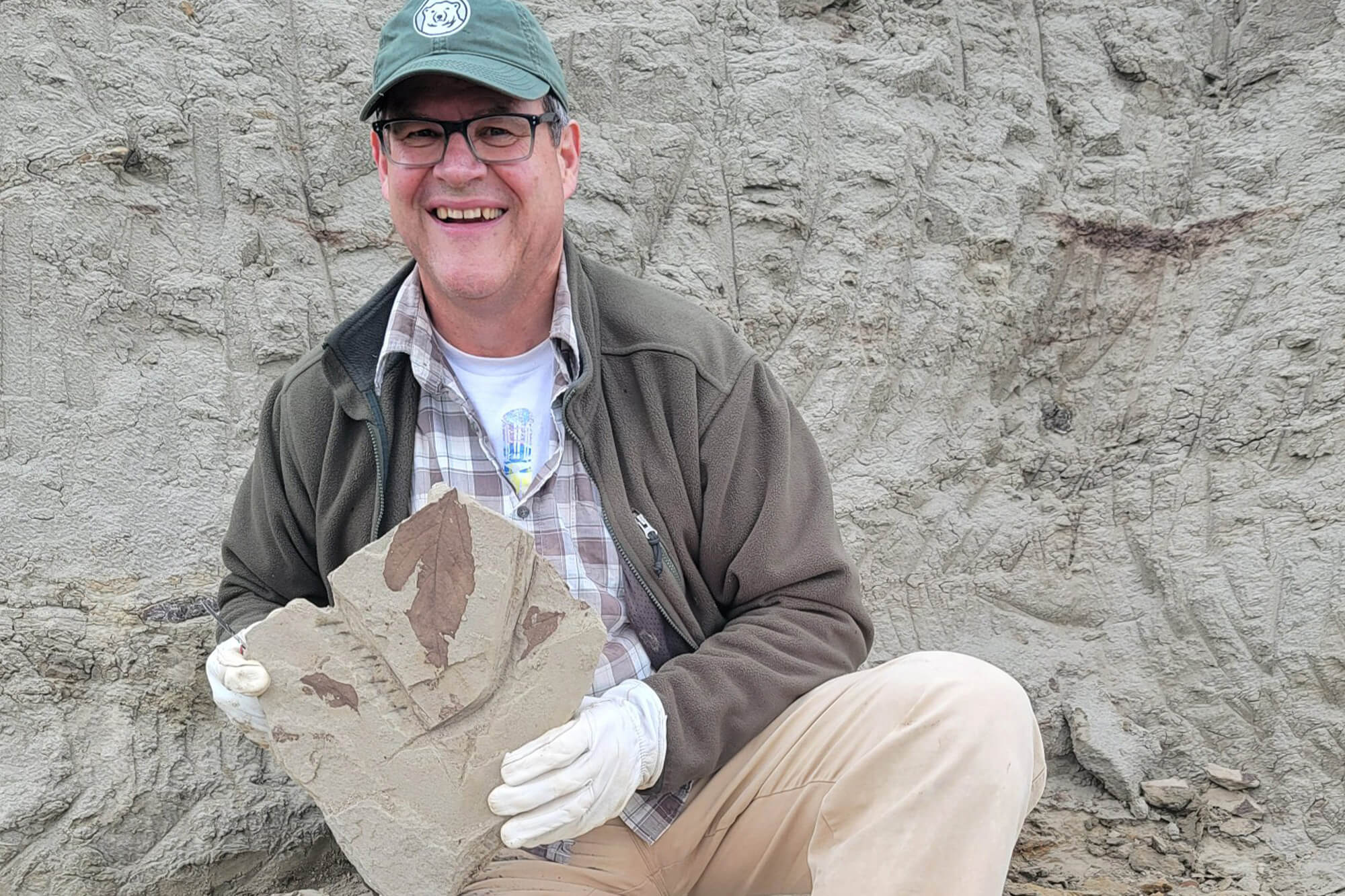
Kirk Johnson, Ph.D., paleobotanist, geologist, and Sant Director of the Smithsonian National Museum of Natural History, smiles while displaying a Late Cretaceous plant fossil specimen during a field excavation. Johnson will serve as the keynote speaker for Casper College’s 30th Annual Tate Field Conference on May 30, 2026. (Kirk Johnson/courtesy photo)
A host of PBS and NOVA shows and documentaries, a published author, geologist, paleobotanist, curator, and the director of the Smithsonian National Museum of Natural History will be the keynote speaker at Casper College’s 30th Annual Tate Field Conference on Saturday, May 30. Tickets are now on sale through May 26 for $30. The cost includes dinner and the presentation that follows.
Kirk Johnson, Ph.D., the Sant Director of the Smithsonian’s NMNH, is a renowned paleobotanist and geologist. Johnson will deliver the keynote address at this year’s Tate Field Conference, titled “Twilight of the Dinosaurs: Terrestrial Life in the Cretaceous.” Johnson’s presentation is titled “The Forests, Meadows, and Ponds of the Late Cretaceous.”
Johnson said he agreed to attend and serve as the keynote speaker “ … because the conference is about the Late Cretaceous, but most of the talks are about animals. I thought they needed some plant content. My talk will use fossil plants to paint a vivid picture of what Wyoming looked like between 71 and 66 million years ago. I can assure you that it will be scintillating,” he joked. Johnson is known for his highly entertaining and enlightening talks, punctuated by his characteristic exuberance and humor.
Johnson hosts a number of NOVA documentaries, including “Polar Extremes,” “Ice Age Footprints,” and “Making North America.” Last year, he appeared as a guest on NOVA’s “Particles of Thought” with Hakeem Oluseyi and on WUCF-TV’s “Global Perspectives” with David Dumke. He hosted and starred in Nature on PBS’s “Walrus: Life on Thin Ice” last October.
His biography notes that Johnson is originally from Bellevue, Washington, and holds a bachelor’s degree in geology and fine arts from Amherst College, a master’s degree in geology and paleobotany from the University of Pennsylvania, and a Ph.D. in geology and paleobotany from Yale University.
He completed postdoctoral research at the University of South Australia in northern Australia’s rainforests, worked as a marine geologist at the U.S. Geological Survey, and served as a Crosby Lecturer at the Massachusetts Institute of Technology. Before joining the Smithsonian in 2012, he was a paleontologist at the Denver Museum of Nature and Science, where he led scientific expeditions worldwide and ultimately served as the museum’s vice president and chief curator.
Johnson ended up at the Smithsonian thanks to a headhunter who approached him about the Sant directorship. Johnson was flattered and intrigued, and the rest is history. As Sant director, Johnson oversees the nation’s natural history collection, which contains more than 148 million specimens and artifacts and comprises the largest collection of its kind in the world. The position is named for Roger and Vicki Sant, who endowed it.
Each year, the museum hosts more than 5 million visitors. In 2024, its scientists published more than 660 peer-reviewed scientific works and named more than 122 new species. According to Johnson, each of the NMNH’s 442 collections, “ … is assigned a specialist curator who is responsible for the intellectual integrity of the collection.” This setup ensures that significant specimens in the vast collection are not overlooked. His Smithsonian biography notes: “In 2023, Johnson led an international effort to quantify the specimens housed in 73 of the world’s largest natural history museums, resulting in a global database that contains more than a billion objects.”
While at DMNS, Johnson led expeditions to 18 states and 11 countries and was a prolific field paleontologist, resulting in fossil excavations on all continents. During his tenure at DMNS, Johnson led the museum’s 2010 Snowmastodon Project, an enormous dig. Johnson called this the discovery he was most excited about. The dig was chronicled in the NOVA show “Ice Age Death Trap.” The recovered bones, approximately 36,000 in total, including 6,500 large bones, are from 52 or more vertebrate animals, including mastodons, mammoths, bison, camels, horses, and other smaller animals. It is estimated that 3,000 of the bones belong to mastodons, ranging from infants to adults, male and female. At the time, Johnson told a New York Times reporter, “The speed of this thing is so unlike normal science — from discovery to completion of one of the biggest digs ever in less than nine months.” That dig was chronicled in the book “Digging Snowmastodon: Discovering an Ice Age World in the Colorado Rockies,” co-authored by Johnson and Ian Miller.
Of all the exhibitions he has worked on, he said his “personal best” was the “Prehistoric Journey” exhibit at the DMNH, which opened in 1995 and is still on exhibit today. The exhibit was also featured in Johnson’s 1995 book “Prehistoric Journey: A History of Life on Earth,” which included color illustrations and photographs of the DMNH’s eight prehistoric habitat dioramas. His current favorite exhibition is the “David H. Koch Hall of Fossils-Deep Time” exhibit at the NMNH, which opened in June 2025. “I oversaw the project, but it was undertaken by a large and talented team,” he noted.
In addition to the current “David H. Koch Hall of Fossils-Deep Time,” the museum has developed many new exhibitions during his tenure as Sant Director at the NMNH, including “Outbreak: Epidemics in a Connected World” and “Cellphone: Unseen Connections,” a special exhibit running through June 2028.
Johnson is the author or co-author of numerous scientific articles, research papers, and book chapters. A list of his more recent research articles is available on Research.com, ScienceDirect, Semantic Scholar, and Google Scholar.
In addition to “Prehistoric Journey: A History of Life on Earth,” and “Digging Snowmastodon: Discovering an Ice Age World in the Colorado Rockies,” he has authored or co-authored other popular books, including “Cruisin’ the Fossil Freeway: An Epoch Tale of a Scientist and an Artist on the Ultimate 5,000-Mile Paleo Road Trip” with illustrator Ray Troll; “Cruisin’ the Fossil Coastline: The Travels of an Artist and a Scientist along the Shores of the Prehistoric Pacific,” also with Troll; “Ancient Denvers: Scenes from the Past 300 Million Years of the Colorado Front Range,” “Ancient Wyoming: A Dozen Lost Worlds Based on the Geology of the Bighorn Basin,” and “Visions of Lost Worlds: The Paleoart of Jay Matternes,” co-authored with Matthew T. Carrano.
The dinner and presentation will be held at the Ramkota Hotel starting at 6 p.m. To purchase tickets, contact Dalene Hodnett, director of museums, at 307-268-3026.
At a Glance:
- Event Focus: Kirk Johnson, Ph.D., will deliver the keynote address, “The Forests, Meadows, and Ponds of the Late Cretaceous,” which explores Wyoming’s ancient plant life from 71 to 66 million years ago.
- Logistics: Saturday, May 30, 2026, starting at 6 p.m. at the Ramkota Hotel.
- Admission: $30 per ticket, includes dinner and the presentation. Tickets must be purchased by Tuesday, May 26, 2026.